Monday, 14 May 2012

Modelo de Trimestral para 2° (ex 9°)


Practice for the exam

A) Match the tools with the words in the box.

 wrench – screwdriver – saw – spanner – hammer – pliers – toolbox


 B) Complete the dialogues with the words in the box


I’m – are – where – is – am – from – an


1. Excuse me, ………………………. (1) you Mario?


Yes, I ………………………. (2).


Nice to meet you. ………………………. (3) Ben.


Are you ………………………. (4) electrician?


No, ………………………. (5) not. I’m a mechanic.


2. My name ………………………. (6) Sven. I’m a welder.


Are you ………………………. (7) Poland?


No, ………………………. (8) from Germany.


3. Excuse me, ………………………. (9) Mr. Smith?


Yes, I ………………………. (10).


Pleased to meet you, Mr. Smith. My name ………………………. (11) Mick Evans.


Nice to meet you, Mr. Evans. ………………………. (12) you from Canada?


No, ………………………. (13) not. I’m from Australia. And you? ………………………. (15) from?


………………………. (16) American.


C) Write out these numbers and units.


1. 7,200 rpm ………………………………………………………………………


2. 254 mm ………………………………………………………………………


3. 159 L ………………………………………………………………………


4. 24 km ………………………………………………………………………


5. 2,518 m ………………………………………………………………………


6. 86 ºC ………………………………………………………………………


7. 12.573 V ………………………………………………………………………


8. 3:55 ………………………………………………………………………


D) Classify the units. Fill in the chart.


Speed
Electricity
Time
Length
Capacity
Temperature


REMEMBER, this is only an exercise for practising at home, or at school... Ask your teacher if you need specific explanation. GOOD LUCK!

Wednesday, 25 April 2012

Lab Project


Energy and Science Projects
For Students

Splitting Water

H2O Hydrolysis

Electricity is "created" when certain chemicals react together. We use chemically-made electricity to power many machines from flashlights to a watch or sometimes a car. Yes, there are cars that run on electricity! The devices that store electricity are called batteries. Electricity can also be used to produce chemical changes.

Water is a simple chemical made from two gases: hydrogen and oxygen. Every molecule of water has two atoms of hydrogen for every atom of oxygen. H2O is the chemical formula for a molecule of water.

If an electrical current is passed through water between electrodes (the positive and minus poles of a battery), the water is split into its two parts: oxygen and hydrogen. This process is called electrolysis and is used in industry in many ways, such as making metals like aluminium. If one of the electrodes is a metal, it will become covered or plated with any metal in the solution. This is how objects are silverplated.

Try This!

You can use electricity to split water into its two gases (oxygen and hydrogen).

What You Need


  • A 9 volt battery
  • Two regular number 2 pencils (remove eraser and metal part on the ends)
  • Salt
  • Thin cardboard
  • Electrical wire
  • Small glass
  • Water


What to Do


  1. Sharpen each pencil at both ends.
  2. Cut the cardboard to fit over glass.
  3. Push the two pencils into the cardboard, about an inch apart.
  4. Dissolve about a teaspoon of salt into the warm water and let sit for a while.
  5. Using one piece of the electrical wire, connect one end on the positive side of the battery and the other to the black graphite (the "lead" of the pencil) at the top of the sharpened pencil. Do the same for the negative side connecting it to the second pencil top.
  6. Place the other two ends of the pencil into the salted water.


HYDROLYSIS

OPPOSITE ATTRACTS...

Hydrolysis is a chemical process in which a certain molecule is split into two parts by the addition of a molecule of water. One fragment of the parent molecule gains a hydrogen ion (H+) from the additional water molecule. The other group collects the remaining hydroxyl group (OH).

The most common hydrolysis occurs when a salt of a weak acid or weak base (or both) is dissolved in water. Water spontaneously ionizes into hydroxyl anions and hydrogen cations. The salt, too, dissociates into its constituent anions and cations. For example, sodium acetate dissociates in water into sodium and acetate ions. Sodium ions react very little with hydroxyl ions whereas acetate ions combine with hydrogen ions to produce neutral acetic acid, and the net result is a relative excess of hydroxyl ions, causing a basic solution.

However, under normal conditions, only a few reactions between water and organic compounds occur. In general, strong acids or bases must be added in order to achieve hydrolysis where water has no effect. The acid or base is considered a catalyst. They are meant to speed up the reaction, but are recovered at the end of it.

Now, try this.

1.      Put two pieces of wire in the bowl with distilled water.

2.      Connect one end to the positive pole of the transformer and the other to the negative pole.

3.      Dissolve some acid substance into the water.

4.      Turn on the transformer.

5.      Collect the gases into the test tubes.

Results


As the electricity from the battery passes through and between the electrodes, the water splits into hydrogen and oxygen.

Now answer:


1.      Which pole collects oxygen?

2.      Why do the oxygen bubbles go to the positive pole?

3.      Where is hydrogen collected?

4.      How much oxygen is there in the test tube?

5.      Do you know water formula?


Finally, draw the circuit between the electrodes, and write its description.


Sunday, 30 October 2011

TECHNICAL ENGLISH BOOK - Pages 36 up to 39


Practice: can - can´t

What can ASIMO do?

1.      Watch the video. Then, answer these questions:

a.      Can Asimo run?

b.      Can Asimo walk backwards?

c.      Can Asimo have a shower?

d.     Does he have breakfast?

e.      Can he go upstairs?

f.       Has he got eyes?

g.      Can he kick a ball?

h.      Does he use a helmet?

2.      Write True or False. 

a.      Asimo can run at six kilometres per hour.

b.      A human arm is like a human arm.

c.      The robot has 7 DOF (Degrees of freedom) in each arm.

d.     Asimo can jump in one leg.

e.      Asimo can recognize faces.

f.       Asimo has sensors for a stable walking.

g.      He can move freely in a human environment.

3.      Complete the chart with a or r.


E0
E3
P3
Asimo
Walk over obstacles


Move objects


Imitate persons


Climb stairs


Run forwards


4.      Now write sentences using the information in the chart. Write five sentences like this:

Example:             E3 can’t imitate persons.

..................................................................

..................................................................

..................................................................

..................................................................

..................................................................

5.      Complete the text with these words: is – can – can’t – are – has  

ASIMO ..................... (1) detect the movements of multiple objects using the cameras he .................... (2) in his head.  He ..................... (3) greet a person when he or she approaches.  

ASIMO ..................... (4) recognize faces, even when ASIMO or the human being is moving. It ..................... (5) individually recognize approximately 10 different faces.

ASIMO ..................... (6) many functions. He ...................... (7) provide news and weather updates via Internet.

Robots ..................... (8) part of our daily life. They ..................... (9) do a lot of things, but they ..................... (10) replace us.


What can ASIMO do?

What can ASIMO do?


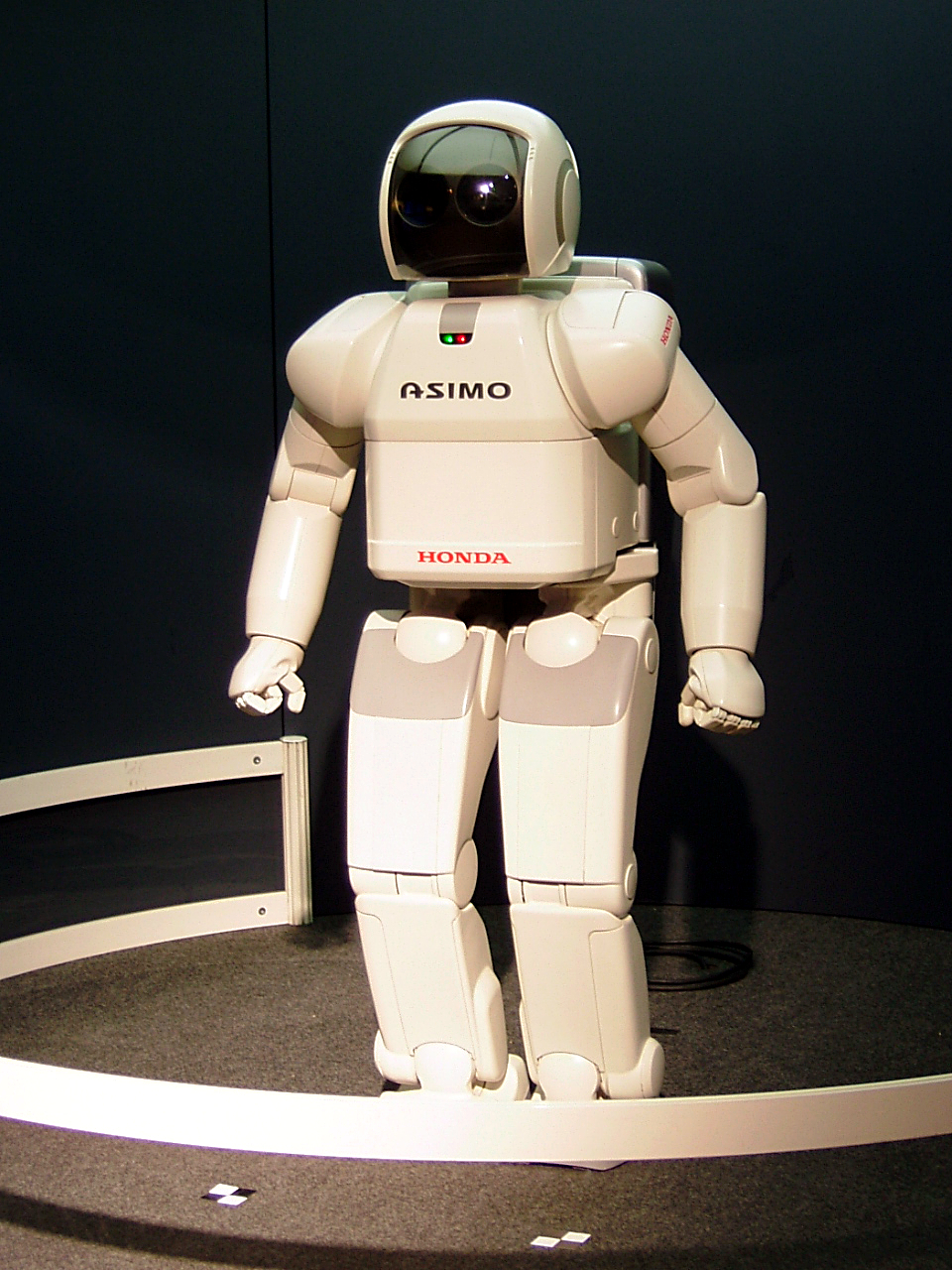
Honda ASIMO


File:HONDA ASIMO.jpg
ASIMO (2000) at the Expo 2005
Manufacturer
Honda
Year of creation
2000

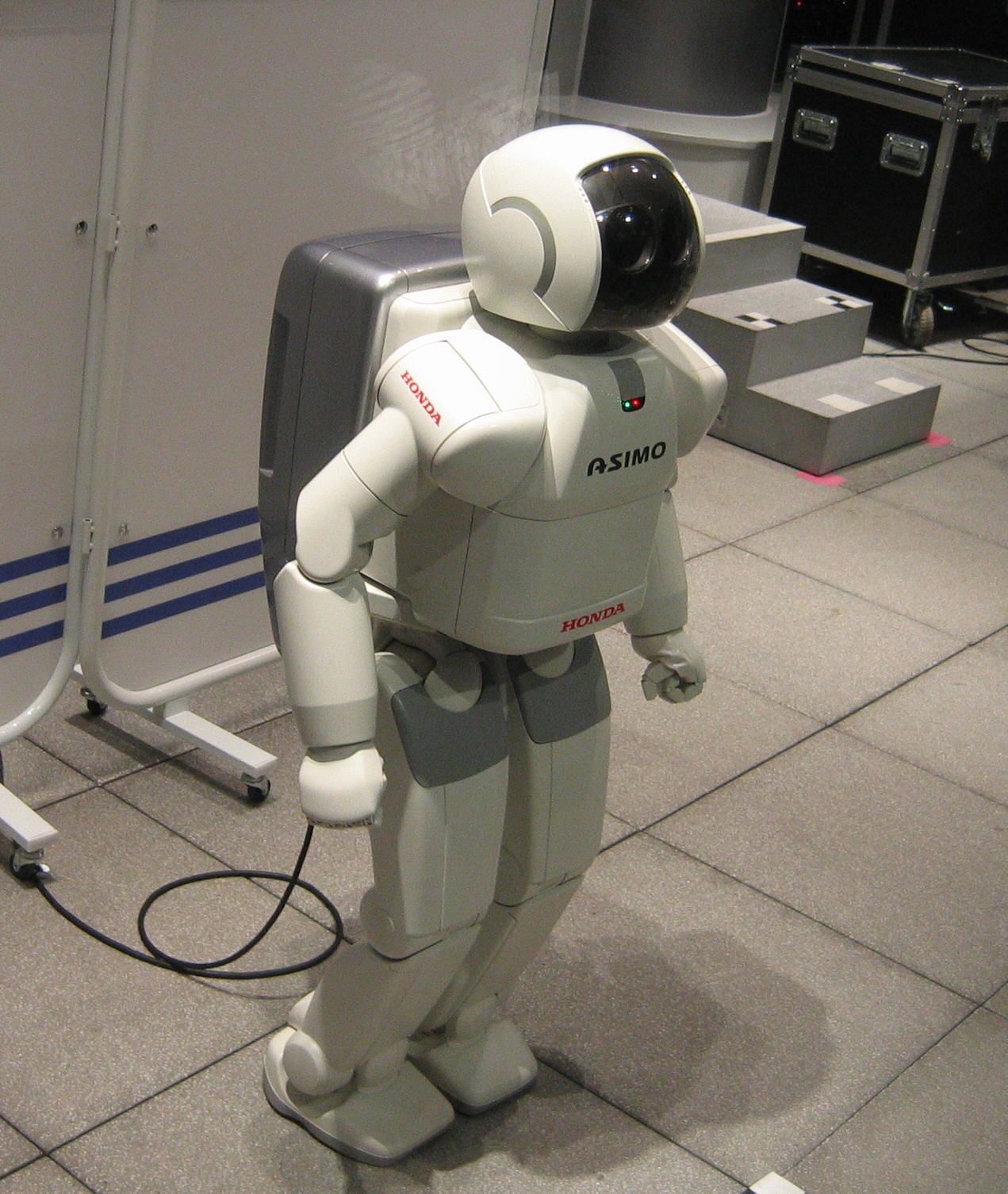
ASIMO (アシモ, ashimo?) is a humanoid robot created by Honda. Standing at 130 centimeters (4 feet 3 inches) and weighing 54 kilograms (114 pounds), the robot resembles a small astronaut wearing a backpack and can walk or run on two feet at speeds up to 6 km/h (3.7 mph), matching EMIEW.

ASIMO was created at Honda's Research & Development Wako Fundamental Technical Research Center in Japan. It is the current model in a line of twelve that began in 1986 with E0. ASIMO resembles a child in size and is the most human-like robot HONDA has made so far. The robot has 7 DOF (Degrees of freedom) in each arm — two joints of 3 DOF, shoulder and wrist, giving "Six degrees of freedom" and 1 DOF at the elbow; 6 DOF in each leg — 3 DOF at the crotch, 2 DOF at the ankle and 1 DOF at the knee; and 3 DOF in the neck joint. The hands have 2 DOF — 1 DOF in each thumb and 1 in each finger. This gives a total of 34 DOF in all joints.

The name is an acronym for "Advanced Step in Innovative MObility". Online magazine The Future Of Things (TFOT) states that Honda did not name the robot in reference to science fiction writer and inventor of the Three Laws of Robotics, Isaac Asimov.

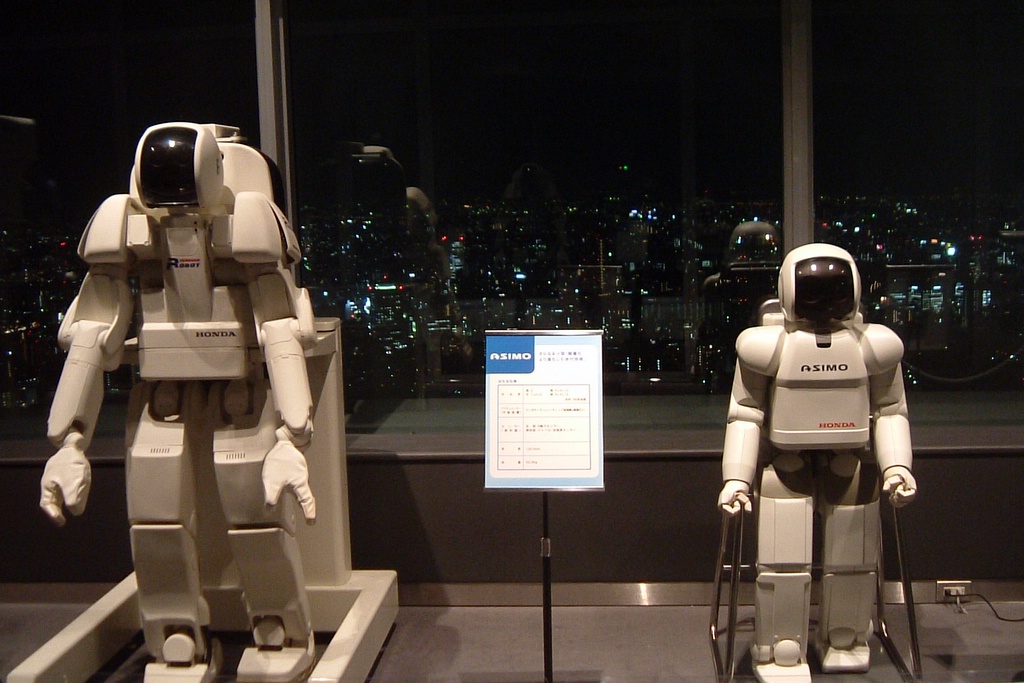
File:Asimo&p3.jpg

P3 model (left) compared to ASIMO

As of February 2009, there are over 100 ASIMO units in existence. Each costs under ¥100 million ($1 million USD) to manufacture.

Development history
Experimental models

The E-series was a collection of successive humanoid robots created by the Honda Motor Company between the years of 1986 and 1993. These robots were only experimental, but later evolved into the Honda P series, with Honda eventually amassing the knowledge and experience necessary to create Honda's advanced humanoid robot: ASIMO. The fact that Honda had been developing the robots was kept secret from the public until the announcement of the Honda P2 in 1996.

E0, developed in 1986, was the very first robot. It walked in a straight line on two feet, in a manner resembling human locomotion, taking around 5 seconds to complete a single step. Quickly engineers realised that in order to walk up slopes, the robot would need to travel faster. The model has 6 degrees of freedom: 1 in each groin, 1 in each knee and 1 in each ankle.

Models

  • E0 developed in 1986
  • E1, developed in 1987, was larger than the first and walked at 0.25 km/h. This model and subsequent E-series robots have 12 degrees of freedom: 3 in each groin, 1 in each knee and 2 in each ankle.
  • E2, developed in 1989, could travel at 1.2km/h, through the development of 'dynamic movement.'[2]
  • E3, developed in 1991, travelled at 3km/h, the average speed of a walking human.[2]
  • E4, developed in 1991, lengthened the knee to achieve speeds of up to 4.7km/h[3]
  • E5, developed in 1992, was able to walk autonomously, albeit with a very large head[3]
  • E6, developed in 1993, was able to autonomously balance, walk over obstacles, and even climb stairs[3]


E0
(1986)
E1
(1987)
E2
(1989)
E3
(1991)
E4
(1991)
E5
(1992)
E6
(1993)
->
P1
(1993)
Weight
16.5 kg
72 kg
67.7 kg
86 kg
150 kg
150 kg
150 kg
175 kg
Height
101.3 cm
128.8 cm
132 cm
136.3 cm
159.5 cm
170 cm
174.3 cm
191.5 cm
6
12
12
12
12
12
12
30
(12 in legs)
Image

 Humanoid prototype models


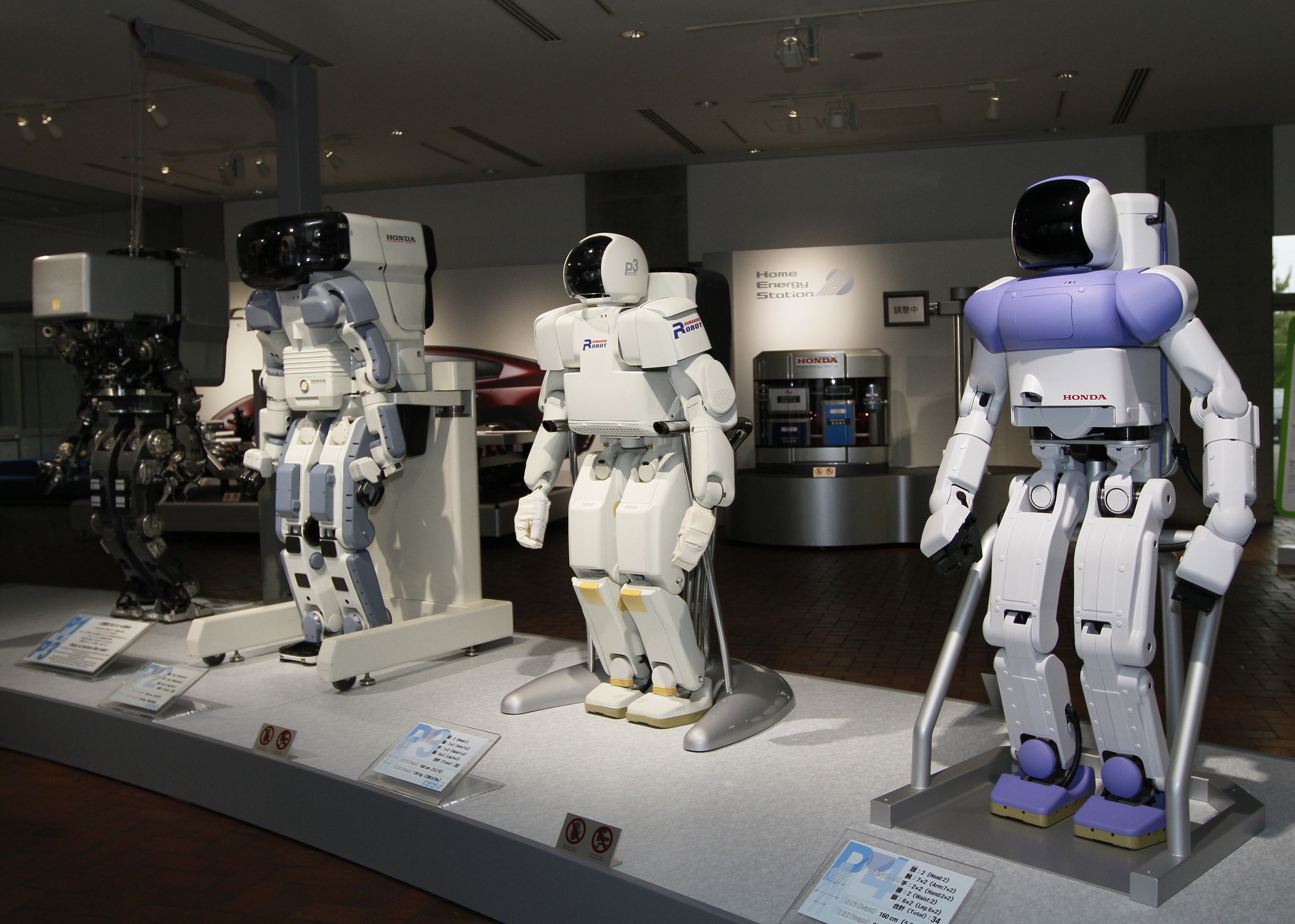
The P-series is a chronological progression of prototype humanoid robots as developed by Honda. The research conducted allowed the eventual creation of ASIMO.

File:Honda prototype robots Honda Collection Hall.jpg

P1, P2, P3 and P4 (from left to right)

  • P1 developed in 1993[1]
  • P2 unveiled in 1996[1]
  • P3 unveiled in 1997[1]


P1
(1993)1
P2
(1996)
P3
(1997)
P4
(2000)2
->
ASIMO
(2000)
ASIMO
(2005)
Weight
175 kg
210 kg
130 kg
80 kg
52 kg
54 kg
Height
191.5 cm
182.0 cm
160.0 cm
160.0 cm
120.0 cm
130.0 cm
Width

60.0 cm
60.0 cm

45.0 cm
45.0 cm
Depth

75.8 cm
55.5 cm

44.0 cm
37.0 cm
Walking speed

2 km/h
2 km/h
2 km/h
1.6 km/h
2.7 km/h (walking)
6 km/h (running)
Max working load

5 kg/hand
2 kg/hand


1 kg (carrying)
10kg (on cart)
Battery
135 V - 6 A·h - Ni-Zn

38.4 V - NiMH
51.8 V - Li-ion
Continuous operating time

15 minutes
25 minutes

30 minutes
1 hour (walking)[2]
30
30
28
34
26
34
Image
      

Features and technology

Specifications

File:Asimo.jpg

Original ASIMO


Model
2000
2004
2005
Mass
52 kg ?
54 kg
Height
120 cm
130 cm
Width
45 cm
45 cm
Depth
44 cm
37 cm
Walking speed
1.6 km/hour
2.5 km/hour
2.7 km/hour
1.6 km/hour (carrying 1 kg)
Running speed
-
3 km/hour
6 km/hour (straight)
5 km/hour (circling)
Airborne time
-
0.05 seconds
0.08 seconds
Battery
Nickel metal hydride
38.4
V / 10 Ah / 7.7 kg
4 hours to fully charge
Lithium ion
51.8
V / 6 kg
3 hours to fully charge
Continuous operating time
30 minutes
40 mins to 1 hour (walking)
26 (two in the head, five in each arm, six in each leg, one per hand)
34 (three in the head, seven in each arm, two in each hand, one in the torso, six in each leg) [10]

Asimo can be operated from a workstation and also by a remote controller. Honda has also created a 3D CPU to power Asimo consisting of three stacked dice: a processor, a signal converter and some memory.  ASIMO runs the VxWorks operating system.

Recognition technology

With 2000's ASIMO model Honda added features that enable ASIMO to interact better with humans. These features fall under 5 categories:

Moving objects
Using the visual information captured by the camera mounted in its head, ASIMO detects the movements of multiple objects, assessing distance and direction. Common applications of this feature would include: the ability to follow the movements of people with its camera, to follow a person, or greet a person when he or she approaches.

Postures and gestures
ASIMO interprets the positioning and movement of a hand, recognizing postures and gestures. Because of this ASIMO can react to and be directed by not only voice commands, but also to the natural movements of human beings. This enables it to, for example, recognize when a handshake is offered or when a person waves and respond accordingly. It can also recognize movement directions such as pointing.

Environment

ASIMO recognizes the objects and terrain of its environment and act in a way that is safe for both itself and nearby humans. For example, recognizing potential hazards such as stairs, and by stopping and starting to avoid hitting humans or other moving objects.

Distinguishing sounds

ASIMO's ability to identify the source of sounds has been improved, and it can distinguish between voices and other sounds. It responds to its name, faces people when spoken to, and recognizes sudden, unusual sounds such as that of a falling object or a collision, and faces in that direction. It can respond to questions, either by a brief nod, a shake of the head or a verbal answer.

Facial recognition

ASIMO can recognize faces, even when ASIMO or the human being is moving. It can individually recognize approximately 10 different faces. Once they are registered it can address them by name.

Network integration

Utilizing networks ASIMO can provide information and function better for various commercial applications such as reception. Its abilities fall under 2 categories:

Integration with user's network system

By connecting with a user's network ASIMO can offer many useful functions such as greeting visitors and informing personnel of the visitor's arrival by transmitting messages and pictures of the visitor's face and guide visitors to a predetermined location.

Internet connectivity

By accessing information via the Internet, ASIMO can, for example, become a provider of news and weather updates.